When we had the website redesigned for ValorWearUSA, we (I mean Catherine) spent untold hours with the IT team. We (I mean I) would do better with a hammer, chisel and a slab of granite than navigate all the techie stuff. Through the process, there was a voluminous transfer of knowledge. Our IT team actually understands the importance of a handler/dog relationship in a K9 team and how it's used in development. They recommended we publish a blog as a result of this knowledge transfer (H/T GBRS Group for the nomenclature).
We will write this blog from first person experiences we either saw, participated in or were on our dogs when we had these experiences. We offer these experiences to this community for growth; ours and the consumer. Any recommendations we make for deployments, gear selection or training comes from those experiences. Some will be funny. Some embarrassing. Some tragic. All for the strengthening of the community we are privileged to be a part of.
Mission profile dictates everything we do. The operation plan identifies, usually in sequential order, what needs to be done. Is what's in front of us a verbal warning for a stop sign violation or a high risk warrant service for a homicide suspect with weapons? Personnel. Times. Places. Approvals. Gear. Non Agency resources. Mutual aid potential. Radio frequency. Medical staging. Aviation requirements.
Every one of these elements present options. Options are decisions. Decisions make or break our success. The lack of success can result in lost prosecutions. Someone getting hurt. Or worse.
Ever watch firefighters maintain their equipment and prepare for the day? How they clean up and prepare for the next call? Why does the SWAT room or building always smell like fresh gun oil? Why is the EOD tech's workspace always clean and tools organized. It's preparation. Preparation is the first step in being successful, or not. If the gear isn't clean, properly maintained, stored correctly and inspected regularly, it will fail. Read that again. It. Will. Fail. Ever watch a Rappel Master inspect, care for and record his/her ropes, carabiners etc, history?
So why is it, generally, K9 cops use a leash, collar, harness, long line or other tools after a deployment and throw that gear on the floorboards, gear bag or front seat with little to no care for what mission was just finished and what may come later in the shift, or worse, leave it on the K9 in the car, kennel or crate?
When we deploy our dogs, what mission parameters are we considering? Are we on scene for a single vehicle sniff for a t-stop or are we climbing Kilimanjaro? Are we out for a bathroom break or a building search? Are we conducting monthly required OB training or are we rappelling from an airframe?
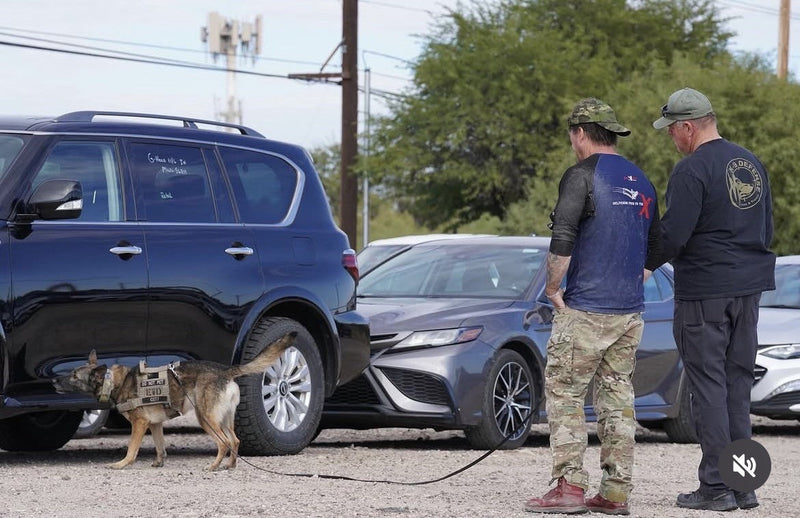
When K9 Yewa #C077 and I were still on active duty only 18 months ago, we had a series of leashes, nine to be exact, all for different purposes and applications. Some Biothane, some high grade full grain leather and others were nylon webbing configurations. Bolt snap, carabiner or Kong Frog? Loose fixed flat collar, minimalist harness or something to better display her creds and purpose. Excessive? Not really. Every piece and every combination of pieces had a specific mission profile related purpose. High visibility foot patrols was a flat collar and a long line almost every time. Proactive area sweeps at an airport on the airfield with multiple aircraft and inbound AF1, high visibility and a harness that would display her creds from a distance and a long line, maybe off leash, if a ground freeze was in effect.
After each deployment, the gear was inspected for damage and wear. It was placed in its proper storage place, set aside for repair or discarded and replaced. Was K9 Yewa ever in her kennel with equipment on her, yes. When deployment needs and other agency requests are rapidly unfolding, she stayed in her gear. Did some get damaged and destroyed? Yes. Does that get expensive, even if you 'know a guy', yes. But what's the price of failure? A thin and lightweight detection line has no place in a building search. Conversely, is a four foot, 14 ounce per square foot, 1" wide leather leash with a Kong Frog 360 carabiner (380 grams) applicable for an extended luggage or motorcade search? I think we agree there would be better and more applicable tools for those jobs.
Whether it's training or a deployment we can do so much to set our dogs and ourselves up for success. This gets more and more challenging as patrol and specialty vehicles continue to shrink on the inside. The importance of this practice cannot be overstated. It is always easier to plan ahead than it is to find what you need in the ubiquitous black nylon gear bag that has as much grass, dirt and dead vegetation as it does actual gear in it. What it does avoid is the "this will work in the moment" approach to gear selection as we so often use.
Perhaps a sports analogy to use is a baseball dugout. All the hitters know what the batting order is. It's published ahead of time. You may not sit in the dugout in batting order as there may be other items requiring attention, a glove needing a quick repair, studying the pitcher's wind up and delivery method. Second baseman's proclivities when a steal sign is on, whatever the case may be. But the bats. The bats are in order. Every spot has a bat and every bat has its place. Home dugout, away game that order only changes with line up. Hockey too, when running shifts and line combinations, a broken stick takes seconds to identify, replace and get that player back in a position to contribute to his linemates on the ice. All because the bat or stick is in the right place at the right time every time. Lacrosse players are the same, perhaps even more nuanced when looking at playing surface, weather conditions and position. They know exactly what they need, why they will need it and where exactly it is. It goes to transition efficiency.
Given that comparison, the meticulous care professional athletes put into the tools of their trade, their profession, it makes sense. Batting averages, slugging percentages and on base percentages all translate into dollars at contract time. Hundreds of millions of them. Inspect, repair, maintain or replace isn't a silly mantra. It's part of the process of being really good at what they do.
When we train or deploy our dogs, there's so much more on the line than a three year contract extension. It's our teammates, the people we serve.